E-commerce Website Design Cost in Lisbon in 2026: Pricing Benchmark & Real Packages
Sakib Al Hasan
Last updated: January 30, 2026
E-commerce website design cost in Lisbon can vary more than most business owners expect. Some stores are simple and quick to launch, while others require deeper UX work, custom layouts, and complex integrations. In 2026, pricing is influenced not only by design quality but also by platform choice, product complexity, and long-term growth needs.
Whether you are launching your first online store or redesigning an existing one, understanding what actually drives cost helps you plan better and avoid surprises. This guide breaks down real price ranges in Lisbon, explains where budgets usually go, and shows how to estimate your e-commerce design investment with confidence.
What E-commerce Website Design Cost Includes in 2026
In 2026, e-commerce website design costs reflect much more than visuals. Businesses in Lisbon are paying for strategy, usability, technical readiness, and conversion performance. Below is a clear breakdown of what is usually included, what affects pricing, and realistic estimated price ranges so you can budget properly.
Core Design and UX Work
This is the foundation of any professional e-commerce project and where most of the value lies.
Item
What’s Included
Estimated Cost (Lisbon)
UX Structure
Navigation, product flow, checkout logic
€1,000 – €3,000
UI Design
Visual design for desktop and mobile
€1,500 – €4,000
Responsive Design
Mobile and tablet optimization
Usually included
This stage ensures customers can browse, compare, and purchase without friction. Better UX directly impacts conversion rates.
Page and Template Design
Most projects include a defined set of templates rather than every page being custom.
Commonly included:
Homepage
Product page
Collection or category page
Cart and checkout
Static pages like About and Policies
Estimated cost:
Theme-based customization: €2,000 – €5,000
Semi-custom layouts: €4,000 – €8,000
Fully custom page systems can push costs higher, especially for larger catalogs.
Platform Setup and Store Configuration
In 2026, agencies usually bundle basic setup into the design cost.
Includes:
Shopify or WooCommerce configuration
Payment gateway setup
Basic tax and shipping rules
Product structure and collections
Estimated cost: €800 – €2,000
This ensures the store is functional, not just visually complete.
What Often Costs Extra
Some services are intentionally excluded from base pricing because needs vary widely.
Extra Service
Typical Price Range
Custom UX research
€1,500 – €4,000
Copywriting
€500 – €2,500
Product photography
€1,000 – €5,000
Advanced animations
€800 – €3,000
CRO optimization
€1,000+ per phase
These are optional but can significantly improve performance and brand quality.
Integrations and Advanced Features
As stores grow, integrations often become a major cost factor.
Examples:
Email marketing and CRM
Inventory or ERP systems
Multi-language and multi-currency
Subscription or membership logic
Estimated cost: €1,000 – €6,000+ depending on complexity.
Typical Total Cost Ranges in Lisbon (2026)
Store Type
Estimated Total Cost
Starter e-commerce store
€3,000 – €6,000
Growth-focused store
€6,000 – €12,000
Advanced or international store
€12,000 – €25,000+
In 2026, e-commerce website design cost in Lisbon represents a complete selling system, not just a storefront. Knowing what is included and where money is spent helps you compare quotes fairly and invest with confidence instead of assumptions.
Lisbon E-commerce Website Design Price Benchmarks
In Lisbon’s growing digital market, e-commerce website design costs vary widely based on experience, scope, and business goals. Knowing local benchmarks helps you set realistic expectations and compare proposals fairly. Below, you’ll find typical price ranges in 2026 for freelancers, small studios, and agencies — reflecting the real Lisbon market.
Freelancer Rates in Lisbon
Freelancers are often the most budget-friendly option for smaller e-commerce projects. Their flexibility makes them suitable for startups or businesses with clear, limited scopes.
Freelancer Level
Typical Hourly Rate
Typical Project Range
Junior
€20 – €30
€1,500 – €4,000
Mid-level
€30 – €45
€3,000 – €7,000
Senior
€45 – €60
€5,000 – €10,000
Freelancers are usually strong in UI design and lightweight store setup, but complex UX, integrations, and custom UI patterns may require additional support.
Small Studio and Boutique Agency Rates
Small Lisbon studios and boutique agencies provide more structure and collaborative processes than freelancers. They often include strategy and UX thinking, which justifies higher pricing.
Studio Tier
Hourly Rate
Typical Project Range
Small Studio
€50 – €75
€6,000 – €12,000
Established Boutique
€75 – €100
€8,000 – €15,000
These providers usually include UX planning, responsive design, and better documentation. They are ideal for growth stores that need conversion-focused layouts and reliable handoffs.
Larger Agency and Premium Studio Pricing
Larger agencies in Lisbon or national/international studios command higher rates and structured delivery processes. They are a good fit for complex, high-impact e-commerce projects.
Agency Tier
Hourly Rate
Typical Project Range
Mid-tier Agency
€90 – €120
€12,000 – €20,000
Premium Agency
€120 – €180+
€20,000 – €40,000+
Higher tiers typically include UX research, CRO guidance, performance optimization, and post-launch strategy support. These teams work well when e-commerce design must scale quickly and support advanced integrations.
How Lisbon Benchmarks Compare
Freelancers are a good entry point for MVPs and lean projects.
Small studios balance cost with process and quality.
Agencies offer stronger strategy, consistency, and continuity, but at a higher price.
These benchmarks reflect the Lisbon market in 2026, where digital commerce demand continues to grow. Knowing these ranges helps you align your budget with the right partner and avoid surprises when requesting proposals or reviewing quotes. If you want, I can help you build a budget estimate form you can send to agencies for fast and accurate pricing. 👊
Cost Breakdown by E-commerce Store Type
E-commerce website design cost in Lisbon depends heavily on the type of store you are building. In 2026, pricing is less about the number of pages and more about complexity, features, and long-term growth needs. Below is a clear breakdown by store type, with realistic Lisbon price ranges.
Starter E-commerce Store
This type of store is ideal for new businesses or brands launching their first online presence. The focus is on speed, clarity, and a clean buying experience.
What’s usually included
Theme-based UI customization
Basic UX structure and navigation
Homepage, product, collection, cart, checkout
Mobile optimization
Basic platform setup
Starter Store Scope
Estimated Cost (Lisbon)
Small catalog (10–30 products)
€3,000 – €5,000
Medium catalog (30–50 products)
€4,000 – €6,000
Starter stores are cost-effective but limited in customization and advanced features.
Growth-Focused E-commerce Store
Growth stores are designed to improve conversion, average order value, and brand credibility. These are common among DTC brands and scaling businesses.
What’s usually included
Custom UI sections and layouts
Conversion-focused UX improvements
Filters, search, and product variations
Upsells, cross-sells, bundles
Improved mobile and checkout experience
Growth Store Scope
Estimated Cost (Lisbon)
Standard growth store
€6,000 – €10,000
Advanced growth store
€10,000 – €15,000
This category balances performance, branding, and scalability.
Advanced or Enterprise E-commerce Store
Advanced stores are built for scale, international markets, or complex operations. These projects require deeper UX strategy and technical planning.
What’s usually included
Fully custom UI/UX design
Multi-language and multi-currency
Custom checkout logic
Advanced integrations (ERP, CRM, inventory)
Performance and CRO planning
Advanced Store Scope
Estimated Cost (Lisbon)
International store
€15,000 – €25,000
Enterprise or custom build
€25,000 – €40,000+
These stores require higher investment but support long-term growth and operational efficiency.
Quick Comparison by Store Type
Store Type
Best For
Typical Budget
Starter
New businesses, MVPs
€3,000 – €6,000
Growth
Scaling brands, DTC
€6,000 – €15,000
Advanced
International or enterprise
€15,000 – €40,000+
Choosing the right store type helps avoid overspending or under-building. The best investment aligns your current business stage with realistic growth plans rather than short-term savings.
Cost Breakdown by Platform Choice
The platform you choose for your e-commerce store heavily influences design cost, technical complexity, and long-term maintenance. In Lisbon’s 2026 market, three major options dominate: Shopify, WooCommerce, and Custom Builds. Each has trade-offs in cost, flexibility, and scalability.
Shopify: Easy Start, Predictable Cost
Shopify is one of the most popular choices for Lisbon e-commerce projects, especially for small and medium-sized stores. It provides reliable hosting, security, and a rich ecosystem of apps. Design costs vary based on how much customization you need beyond a base theme.
Basic app setup (reviews, social login, analytics)
Responsive design
Shopify Scope
Estimated Cost (Lisbon)
Basic theme customization
€3,000 – €6,000
Custom sections and intermediate UX
€6,000 – €10,000
Heavily customized, UX-driven build
€10,000 – €15,000+
Why costs varyShopify themes make early design faster. However, heavy personalization, custom templates, and advanced app integrations increase design and developer time. Shopify’s ecosystem also has subscription costs in addition to design fees.
WooCommerce: Flexible but More Hands-On
WooCommerce runs on WordPress and gives more control over backend logic, content, and database structure. It’s excellent for stores that want flexibility without completely custom systems. However, design and integration require more effort because many elements are not as “turnkey” as Shopify.
What’s usually included
Theme customization or custom theme creation
Product, category, cart, and checkout templates
Plugin setup for payments, shipping, analytics
Responsive design and user flows
WooCommerce Scope
Estimated Cost (Lisbon)
Basic design with off-the-shelf theme
€4,000 – €7,000
Custom theme or UX improvements
€7,000 – €12,000
Full customization with plugins
€12,000 – €18,000+
Why costs varyWooCommerce requires careful plugin selection and compatibility checks, which adds to planning and QA time. Hosting choices also affect performance optimization, which impacts cost.
Custom Build: Maximum Flexibility, Higher Price
Custom e-commerce platforms are ideal when off-the-shelf solutions cannot satisfy business logic. This includes headless setups, complex pricing rules, multi-tenant systems, and unique customer experiences.
What’s usually included
Full UI/UX design from scratch
Custom checkout and pricing logic
API integrations with systems like ERP, CRM, or inventory
Scalable architecture, performance planning
Custom E-commerce
Estimated Cost (Lisbon)
Mid-level custom solution
€18,000 – €30,000
Enterprise-grade build
€30,000 – €60,000+
Why costs are higherCustom builds demand deep UX strategy, engineering coordination, and longer timelines. They require detailed planning, documentation, and QA across complex use cases.
Platform
Best For
Typical Design Cost
Flexibility
Shopify
Fast launch, predictable pricing
€3,000 – €15,000+
Medium
WooCommerce
Flexible open-source stores
€4,000 – €18,000+
High
Custom Build
Unique systems, enterprise needs
€18,000 – €60,000+
Very High
Quick Platform Comparison
Choosing a platform is a strategic decision. Shopify keeps costs predictable and supports many stores out of the box, while WooCommerce and custom solutions offer deeper customization at higher design and maintenance effort. If you want, I can add which platform suits your business case based on your product needs.
Key Factors That Increase or Reduce E-commerce Design Cost
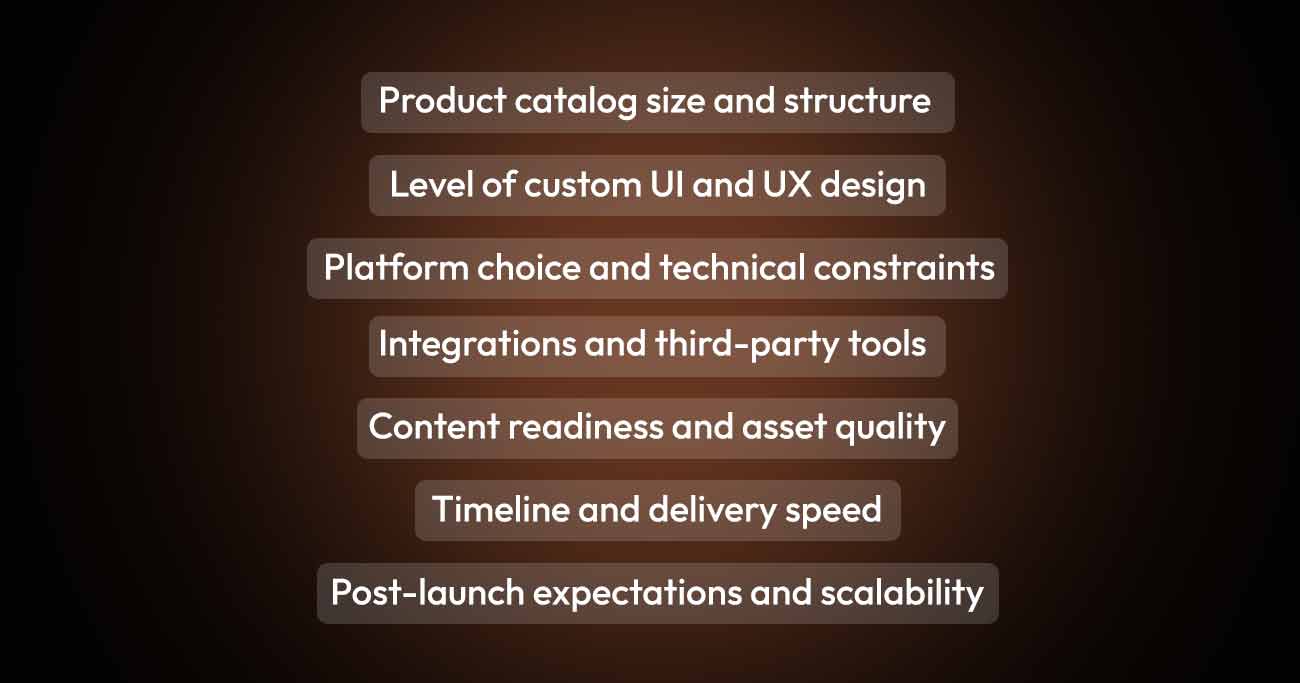
Image Description: Blog section outlining key factors that increase or reduce e commerce design costs, focusing on product catalog structure, customization level, platform choice, and technical constraints.
Alt Text: E-commerce design cost factors
E-commerce website design cost is not fixed. In Lisbon, prices in 2026 shift based on a set of practical factors that directly affect scope, time, and complexity. Understanding these factors helps businesses control budgets and avoid unnecessary spending.
1. Product catalog size and structure
The number of products alone does not define cost, but how those products are structured does. A store with 20 simple products is far cheaper to design than one with 20 products that each have multiple variants, attributes, and custom options. Filters, sorting, and collection logic add design and UX complexity. The more decisions a user must make while browsing, the more thought and testing the interface requires, which increases cost.
2. Level of custom UI and UX design
Using an existing theme with light customization keeps costs lower. Fully custom UI and UX design increases cost significantly. Custom layouts, unique interactions, and brand-specific components require more design time and closer collaboration with developers. While custom design improves differentiation and conversion, it also increases upfront investment. Businesses that prioritize speed over uniqueness usually spend less here.
3. Platform choice and technical constraints
Different platforms impose different design limits. Shopify speeds up design and implementation but becomes expensive when heavy customization is required. WooCommerce allows more flexibility but requires extra planning and QA due to plugins and hosting variables. Custom platforms demand the most design effort because every flow is built from scratch. Platform choice directly affects how much design work is needed to achieve the desired experience.
4. Integrations and third-party tools
Integrations are one of the most common cost multipliers. Payment gateways, shipping systems, inventory management, CRM tools, and marketing platforms all require UX consideration. Each integration affects user flows, error handling, and edge cases. The more systems a store connects to, the more screens, states, and logic designers must account for. This increases both design and testing time.
5. Content readiness and asset quality
Many businesses underestimate how much content affects cost. When product images, copy, brand guidelines, and policies are ready, design moves faster. When content is missing or low quality, designers must work around placeholders or revise layouts later. Late content changes often cause redesigns, which increase cost. Well-prepared content reduces friction and keeps projects on budget.
6. Timeline and delivery speed
Tight deadlines usually increase cost. Faster delivery often requires more designers, parallel work, or reduced iteration cycles. This raises hourly rates or total project fees. Flexible timelines allow teams to work efficiently, test properly, and avoid rushed decisions. Businesses that plan ahead usually pay less for better results.
7. Post-launch expectations and scalability
Designing only for launch is cheaper than designing for growth. Stores that plan for future features, international expansion, or ongoing optimization require stronger design systems and reusable components. This increases upfront cost but reduces redesign expenses later. Businesses that think long term often spend more initially but save money as the store scales.
E-commerce design cost is shaped by decisions made early. The clearer the business goals, product scope, and growth plans, the easier it is to balance budget, quality, and long-term value.
Ongoing and Hidden Costs Most Businesses Miss
Many businesses focus only on the upfront e-commerce website design cost and overlook the expenses that appear after launch. In Lisbon, these ongoing and hidden costs often determine whether a store remains profitable and scalable in the long run.
Platform fees and subscriptions
Most e-commerce platforms charge monthly fees that increase as the business grows. Shopify plans, premium themes, and paid apps add recurring costs that are easy to underestimate at the start. Even WooCommerce stores, which appear cheaper upfront, require hosting, security tools, and premium plugins. Over a year, these subscriptions can add thousands of euros to the total cost of ownership.
App and plugin dependency
Modern e-commerce stores rely heavily on third-party apps for reviews, email marketing, upsells, analytics, and automation. Each app may seem affordable on its own, but combined costs add up quickly. As stores grow, businesses often need more advanced plans, which increases monthly expenses without any visible design changes.
Maintenance and technical updates
Websites are not set-and-forget assets. Regular updates are required to keep themes, plugins, and integrations secure and compatible. Without ongoing maintenance, stores risk performance issues or downtime. Many Lisbon agencies recommend a monthly maintenance budget to cover bug fixes, minor improvements, and technical support.
Performance and speed optimization
As product catalogs grow and features are added, site performance often declines. Improving load speed, mobile performance, and Core Web Vitals usually requires additional design and development work. These optimizations are rarely included in the original design cost but are critical for SEO and conversion rates.
Conversion optimization and UX improvements
Launching a store is only the beginning. Real user behavior often reveals friction points that were not obvious during design. Improving checkout flow, product pages, or navigation usually requires follow-up UX and UI work. Ongoing optimization is a recurring cost but also one of the highest-return investments.
Content updates and new assets
New products, campaigns, seasonal promotions, and brand updates all require design support. Creating banners, landing pages, and updated visuals becomes a recurring expense. Businesses that do not budget for content updates often end up with outdated or inconsistent stores.
Understanding these ongoing and hidden costs helps businesses plan more realistically. A well-designed e-commerce store is an evolving system, not a one-time expense, and budgeting for growth prevents costly surprises later.
How Lisbon Agencies and Studios Package E-commerce Projects
Lisbon agencies and studios rarely sell e-commerce projects as a single flat service. In 2026, most providers package their work based on scope clarity, growth expectations, and how involved they will be after launch. Understanding these common packaging models helps businesses compare proposals more accurately.
Build-only packages
This is the most straightforward option and is often chosen by startups or businesses with tight timelines. Build-only packages focus on designing and launching the store. They usually include UX structure, UI design, core templates, basic platform setup, and launch support. Once the store goes live, the project ends. These packages are easier to price and typically lower cost, but they offer limited flexibility after delivery.
Build plus optimization packages
Many Lisbon studios offer a build plus optimization model for growth-focused brands. Along with design and launch, this package includes early conversion optimization, usability improvements, and performance tuning based on initial user behavior. This approach costs more upfront but helps stores perform better after launch. It is common for agencies that specialize in UX and CRO.
Build with monthly support retainers
For businesses planning continuous growth, agencies often bundle the build with a monthly retainer. After launch, the team stays involved to handle improvements, new features, design updates, and testing. This model spreads cost over time and ensures consistency. It is popular with scaling e-commerce brands that want an ongoing design partner.
Hourly or flexible engagement models
Some studios offer flexible hourly packages for e-commerce work, especially for Shopify stores. This model suits businesses that need ongoing but unpredictable support. While flexible, it requires clear prioritization to control costs.
Why fixed prices are rare
Most Lisbon agencies avoid fixed pricing without clear scope. E-commerce complexity varies widely, so packages are designed to match business stage rather than promise one-size-fits-all pricing.
Understanding these packaging models helps businesses choose the right level of support instead of comparing prices alone.
How to Estimate Your E-commerce Website Design Budget Accurately
Estimating an e-commerce website design budget accurately is less about guessing a number and more about understanding your real needs. In Lisbon’s 2026 market, businesses that plan clearly tend to save money and avoid scope creep.
Start by defining your store type and goals
First, be clear about what kind of store you are building. A starter store, a growth-focused store, and an advanced or international store all require very different budgets. Define whether your main goal is fast launch, conversion improvement, or long-term scalability. Budget estimation becomes much easier once the goal is clear.
List your must-have features, not nice-to-haves
Separate essential features from optional ones. Essentials usually include core pages, checkout flow, mobile optimization, and basic integrations. Nice-to-haves might be animations, advanced filters, or custom interactions. This prioritization helps agencies give realistic estimates and protects your budget from unnecessary extras.
Decide on platform early
Choosing Shopify, WooCommerce, or a custom solution upfront removes a lot of uncertainty. Platform choice directly affects design effort, customization limits, and ongoing costs. Changing platforms mid-project almost always increases budget.
Count complexity, not pages
Instead of counting pages, think about complexity. Product variations, filters, user accounts, subscriptions, and integrations add more cost than simple static pages. Sharing this detail with agencies leads to more accurate quotes.
Plan for post-launch costs
Include a budget for maintenance, small improvements, and optimization after launch. A realistic estimate always accounts for what happens after the store goes live.
When businesses define scope, priorities, and growth plans early, budget estimation becomes predictable instead of stressful.
PlutoHub’s Approach to Cost-Effective E-commerce Design
PlutoHub focuses on cost-effective e-commerce design by aligning design decisions with real business goals, not unnecessary features. Instead of overbuilding, we help businesses invest where it matters most, such as product discovery, checkout flow, and mobile usability. This approach reduces wasted spend while improving conversion and customer experience.
We work closely with clients to define scope early, prioritize must-have features, and choose the right platform based on growth plans and budget. By combining strong UX planning with scalable UI systems, we reduce redesign costs later and speed up development. The result is an e-commerce store that launches efficiently, performs better from day one, and remains flexible as the business grows, without unexpected cost overruns.
FAQs
How does PlutoHub keep e-commerce design costs under control?
We focus on clear scope definition and prioritization. By identifying must-have features early and avoiding unnecessary customization, we help businesses invest only in what drives real results.
Can PlutoHub work with different e-commerce platforms?
Yes. We design for Shopify, WooCommerce, and custom solutions. Platform recommendations are based on business goals, budget, and long-term scalability, not preferences.
Do you offer support after the store is launched?
Yes. We provide post-launch support for improvements, performance optimization, and new features. This helps stores grow without the need for frequent redesigns.
How early should businesses involve PlutoHub in budgeting?
The earlier, the better. Involving us during planning helps avoid unrealistic expectations and allows for more accurate budget estimates from the start.
Can you redesign an existing store without rebuilding everything?
Yes. We often improve UX, UI, and conversion without a full rebuild. This approach saves cost while addressing performance issues.
What makes PlutoHub different from other e-commerce agencies?
We balance design quality, usability, and cost. Our focus is on long-term value, scalable systems, and measurable business impact rather than one-time visuals.
Mobile App Design
We Create Unique Digital Experiences For Global Brands By Integrating AI, Innovative Design, And Advanced Technology.







Sakib Al Hasan
Leave a Reply